Ai innovation
What Is a Forward Deployed Engineer (and When Your Company Needs One)
What is a forward deployed engineer? Learn how embedded engineering beats traditional outsourcing for AI, Laravel, and ops-critical software—and when the FDE model fits.
Introduction
Your roadmap is clear. Your budget is approved. Six months later, the vendor delivers something that technically matches the spec — but nobody on your operations team wants to use it.
That gap rarely comes from bad code. It comes from distance: engineers who never sat with the people doing the work, never watched a real workflow break at 4 p.m. on a Friday, and never felt the pressure to ship a fix before Monday's peak volume.
The forward deployed engineer model exists to close that gap. Popularized in high-stakes software by companies like Palantir, the approach is now spreading into mid-market SaaS, e-commerce platforms, and enterprise AI rollouts — anywhere context matters as much as capacity.
If you are evaluating custom software partners, comparing offshore quotes, or trying to rescue a project that looks fine in Jira but fails in production, this guide will help you decide whether a forward deployed engineer (FDE) belongs in your delivery model — and what to expect when you embed one.
What Is a Forward Deployed Engineer?
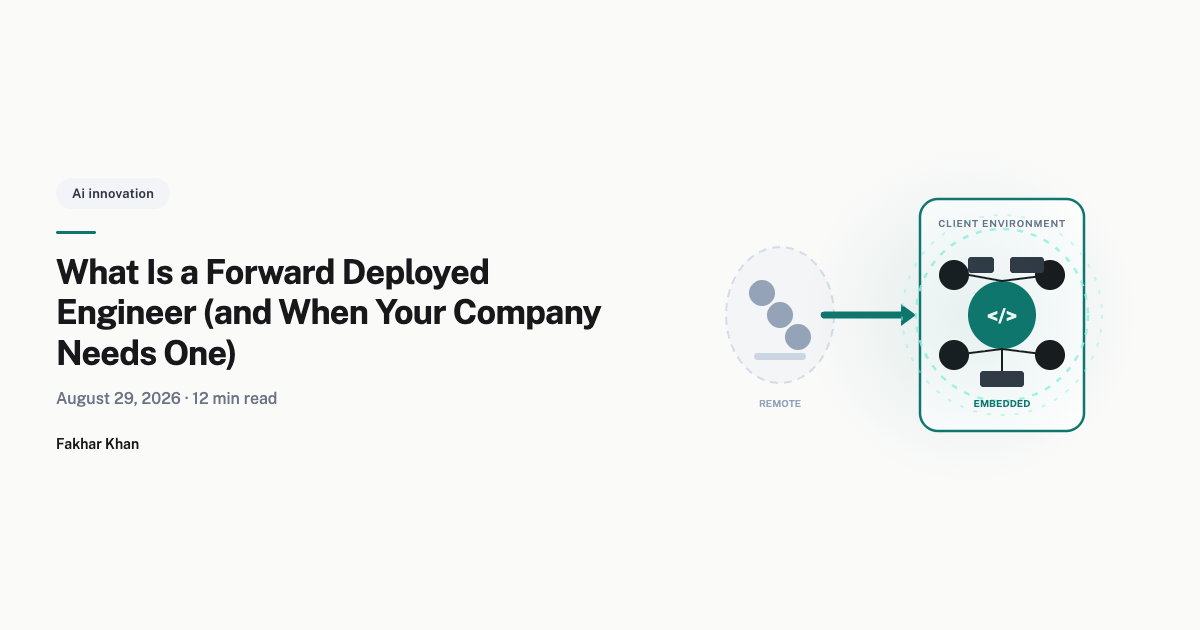
A forward deployed engineer is a senior technical builder who works inside your environment — your Slack channels, your standups, your repos, your staging stack, and often your daily working rhythm with stakeholders.
Unlike a developer who only receives tickets through a distant project manager, an FDE:
- Discovers problems alongside your team, not from a requirements document frozen three months ago
- Builds in your stack, your CI/CD pipeline, and your cloud accounts (with appropriate access controls)
- Ships iteratively with your people in the loop, not in a big-bang handoff at phase end
- Translates between business urgency and engineering trade-offs in real time — in the meeting, not in a follow-up email
The title varies by company — embedded engineer, deployment strategist, technical partner, customer-facing software engineer — but the idea is consistent: move the engineer forward, into the problem, instead of keeping them behind a procurement wall.
Think of the difference between a consultant who writes a report about your warehouse and an engineer who spends a week on the floor, then ships a routing fix before peak season. Same domain. Different proximity. Different outcome.
Why Forward Deployment Is Trending Now
Three forces are pushing the FDE model from Silicon Valley job boards into mainstream procurement conversations:
1. AI projects expose context gaps faster than traditional apps.
A classification model or agent workflow can look impressive in a demo and still fail in production because it never learned how your support team actually categorizes edge cases, or how your sales team abbreviates product names. Builders who are not embedded miss those details until after launch.
2. Buyers optimize for outcomes, not activity.
Leadership teams are tired of paying for sprint velocity that does not move revenue, reduce cost, or improve adoption. Embedded engineers are measured on working software in real conditions, not ticket closure rates.
3. Remote-only delivery created a feedback tax.
Offshore and async-only models work for well-specified work. They struggle when requirements evolve weekly — which is the default state for AI pilots, ERP integrations, and internal ops tools. Every round-trip across time zones adds days of misunderstanding that compound into rework.
The result: more CTOs and founders are asking not "how many developers can you staff?" but "who will sit with us and ship?"
What Forward Deployed Engineers Do Day to Day
An effective FDE week looks less like a Gantt chart and more like a product squad operating inside your company:
- Morning sync with your product owner or ops lead — what broke overnight, what changed in the business, what is blocked
- Working sessions with users or internal champions — observe workflows, capture edge cases, validate assumptions before they become schema
- Build and deploy small, verifiable increments — an API endpoint, a dashboard, an automation, a model integration, a data pipeline fix
- Same-day or next-day feedback — adjust before wrong assumptions harden into expensive technical debt
- Continuous documentation — runbooks, ADRs, and handoff notes as habits, not a panic in the final week
For AI and automation specifically, this rhythm is non-negotiable. Prompts, tool chains, and agent workflows fail quietly when builders never see how staff override defaults, phrase requests, or work around broken steps. An embedded engineer catches misalignment in week one, not month four.
What separates a strong FDE from a generic contractor
| Trait | Weak fit | Strong FDE |
|---|---|---|
| Communication | Waits for written specs | Asks clarifying questions in live working sessions |
| Scope | Builds exactly what was asked | Challenges requirements that will not survive contact with users |
| Delivery | Optimizes for milestone sign-off | Optimizes for production adoption |
| Stack | Insists on greenfield rewrite | Works in your Laravel, React, or legacy stack where sensible |
| Handoff | Disappears after launch | Leaves runbooks your team can operate without them |
The best FDEs combine senior engineering judgment with enough product instinct to say, "That requirement will not survive your busiest Tuesday — here is a better path."
How FDE Compares to Other Delivery Models
Not every initiative needs embedded engineering. Here is an honest comparison:
| Model | Where engineers work | Context on your business | Speed to first value | Best when |
|---|---|---|---|---|
| Fixed-price project | Vendor team, your specs | Low | Slow (batch milestones) | Scope is stable and well documented |
| Staff augmentation | Your team, your backlog | Medium | Depends on your PM | You need extra hands on a known stack |
| Offshore development center | Remote factory | Low–medium | Lower cost, slower feedback | Commodity features, long timelines acceptable |
| Forward deployed engineer | Embedded with you | High | Fast iteration | Complex, evolving, or high-stakes problems |
Traditional outsourcing optimizes for cost per hour. Forward deployment optimizes for cost per outcome — fewer rebuilds, fewer "that is not what we meant" cycles, and faster time to software your team actually uses.
Staff augmentation can look similar on paper. The difference is accountability: staff aug fills seats; an FDE owns a problem slice end-to-end and is judged on whether the workflow works in production.
When Your Company Needs a Forward Deployed Engineer
Consider embedded engineering when:
- Requirements will change — AI pilots, new product lines, regulatory shifts, or integrations you have not fully mapped
- The problem is operational, not cosmetic — order routing, multi-system data sync, ERP glue, internal tools that touch revenue or fulfillment
- Adoption is the success metric — if internal users or customers will not use it, the project failed regardless of test coverage
- You lack senior bench strength — your team maintains production well but is stretched for greenfield architecture or AI production patterns
- Latency is expensive — every week of misaligned build costs real money in lost productivity, support load, or missed market window
- You are integrating AI into existing workflows — not building a standalone chatbot, but changing how work actually gets done
Industries where we see this pattern repeatedly: real estate technology, e-commerce, B2B SaaS, education platforms, and enterprise operations where spreadsheets and legacy tools finally hit their limit.
When You Do Not Need an FDE
Embedded engineering is not always the answer. Skip it when:
- You have a frozen spec and a commodity build — a standard marketing site, a brochure app with no custom logic
- You run a high-functioning internal product team and only need temporary capacity; staff aug may be enough
- Security or compliance forbids external access to production or customer data — consider a hybrid: embedded discovery and architecture, isolated build environments
- You are optimizing purely for lowest hourly rate on well-understood CRUD — a traditional offshore quote may win on paper, and that may be the rational choice
The goal is fit, not fashion. Forward deployment is a delivery model, not a badge you paste on every RFP.
What Embedded Delivery Looks Like in Practice
Consider a composite scenario we see often — details changed, pattern real.
A mid-size company runs a multi-source data platform: listings from partners, internal MLS feeds, and legacy CSV pipelines. The business team needs a unified search experience. Two prior vendor attempts delivered "complete" modules that nobody trusted because edge cases — duplicate addresses, stale status flags, timezone mismatches — only surfaced when agents used the tool under deadline pressure.
An embedded engineer joined daily standups, shadowed two account managers for half a day, and traced one bad record from source API through sanitization to index. Within ten days, the team had a corrected pipeline in staging, a monitoring dashboard ops actually checked, and a written runbook for the three failure modes that caused 80% of support tickets.
That is forward deployment: not a bigger team, but a senior builder where the failure happens.
The same pattern applies to AI rollouts — an internal copilot that drafts customer replies, an automation that routes leads, an agent that calls internal APIs. Proximity turns vague "make it smarter" requests into shippable, measurable increments.
Forward Deployed Engineers and AI Projects
AI initiatives are where the FDE model earns its keep — and where distant delivery fails most visibly.
Embedded engineers help you:
- Map real workflows before choosing models, tools, or agent architectures
- Define guardrails — permissions, human-in-the-loop steps, audit logs — in the same sprint as the feature, not as a phase-two afterthought
- Evaluate in production-like conditions — real prompts, real data boundaries, real latency under load
- Integrate with your stack — Laravel APIs, React admin panels, n8n orchestration, existing auth and tenancy — instead of bolting on a standalone demo
If your AI strategy lives in slide decks while your ops team still copies data between systems manually, you do not need more models. You need someone forward-deployed into the workflow long enough to automate what actually hurts.
How Soft Pyramid Approaches Embedded Engineering
At Soft Pyramid, we have spent more than 13 years shipping custom software for businesses worldwide — Laravel platforms, React frontends, SaaS products, APIs, ERP integrations, and production AI workflows. Across 200+ projects, the engagements clients retain longest share one trait: engineers who stay close to the problem.
Our embedded model is built for leaders who want outcomes without losing visibility:
- US-aligned leadership from our Frisco, Texas office, with senior engineers integrated into your communication rhythm
- Direct access — no layers of account managers filtering every technical question
- Build in your ecosystem — your Git, your CI/CD, your cloud, your standards wherever security policy allows
- Phased outcomes — a short discovery embed, then iterative delivery with clear weekly or biweekly milestones
- Depth where it counts — AI solutions, SaaS development, API and integration work, and automation patterns that survive production traffic
We are not selling "bodies on a bench." We offer forward-deployed builders who treat your roadmap like their own sprint board — because when you win, the partnership continues. That shows up in long-running relationships across real estate, e-commerce, education, and B2B SaaS, including platforms where data quality and uptime directly affect revenue.
Explore how we have applied this discipline in production environments on our case studies page.
A Low-Risk Way to Start
You do not need to restructure your entire vendor strategy on day one. A practical entry path:
- Discovery embed (typically two weeks) — a senior engineer joins your team, maps workflows, identifies constraints, and delivers a written plan with architecture options and effort ranges
- Pilot build — one high-value workflow shipped to staging or production with your people in the loop
- Scale or transition — extend embedded capacity for the next problem slice, or hand off to your internal team with documentation and runbooks they can operate
If the pilot does not prove faster alignment than your last fixed-price engagement, you still leave with clearer architecture, documented workflows, and a honest map of what full delivery would require. That alone saves budget on the next attempt.
Frequently Asked Questions
Is a forward deployed engineer the same as staff augmentation?
Staff aug adds capacity to your backlog. An FDE owns a problem outcome — discovery through production — and is accountable for whether the workflow actually works for users.
Do FDEs need to be on-site?
Not always. What matters is embedded access: daily communication, live working sessions, and permission to deploy and observe in environments that reflect reality. Hybrid and remote-forward deployments work when rhythm and access are deliberate.
How is this different from a fixed-price agency project?
Fixed-price works when scope is stable. FDE fits when scope evolves, stakes are high, or adoption — not demo completion — defines success.
What stacks do forward deployed engineers work in?
Strong FDEs go where the problem lives. At Soft Pyramid, that commonly means Laravel, React, Vue, Node, cloud-native APIs, and AI/automation layers — integrated into existing systems rather than forcing a rewrite.
When should we choose offshore instead?
When requirements are frozen, interfaces are well defined, timeline pressure is low, and your internal team can absorb integration and product decisions. Offshore and FDE solve different optimization problems.
Conclusion
A forward deployed engineer brings senior technical judgment into the room where decisions happen — not six time zones away from it. For complex software, AI rollouts, and operations-critical systems, that proximity is often the difference between software that ships and software that sticks.
Key takeaways:
- FDEs embed with your team to discover, build, and iterate in your real environment
- The model wins when context, adoption, and speed matter more than lowest hourly cost
- AI and automation initiatives especially benefit from embedded discovery and production-grade guardrails
- It is not for every project — commodity builds and fully staffed internal teams may not need it
- Start with a short discovery embed before committing to a long engagement
Ready to explore embedded engineering for your next initiative? Schedule a consultation with Soft Pyramid. We will help you assess whether forward deployment fits your timeline, stack, and goals — honestly, including when another model is the better call.

Fakhar Khan
If this is the problem you are staring at, let's talk about it.
Architecture, AI operations, and delivery for US small and mid-size companies — outcomes first.